THE PLAIN-LANGUAGE GUIDE · CANADA
Peptides, made simple.
What they are. How they work. Which benefits have proof. A clear guide for readers in Canada.
By GotPeptide · Sources checked
A learning guide for adults. Read it at your own pace. It is not a treatment plan.
Start with the benefits →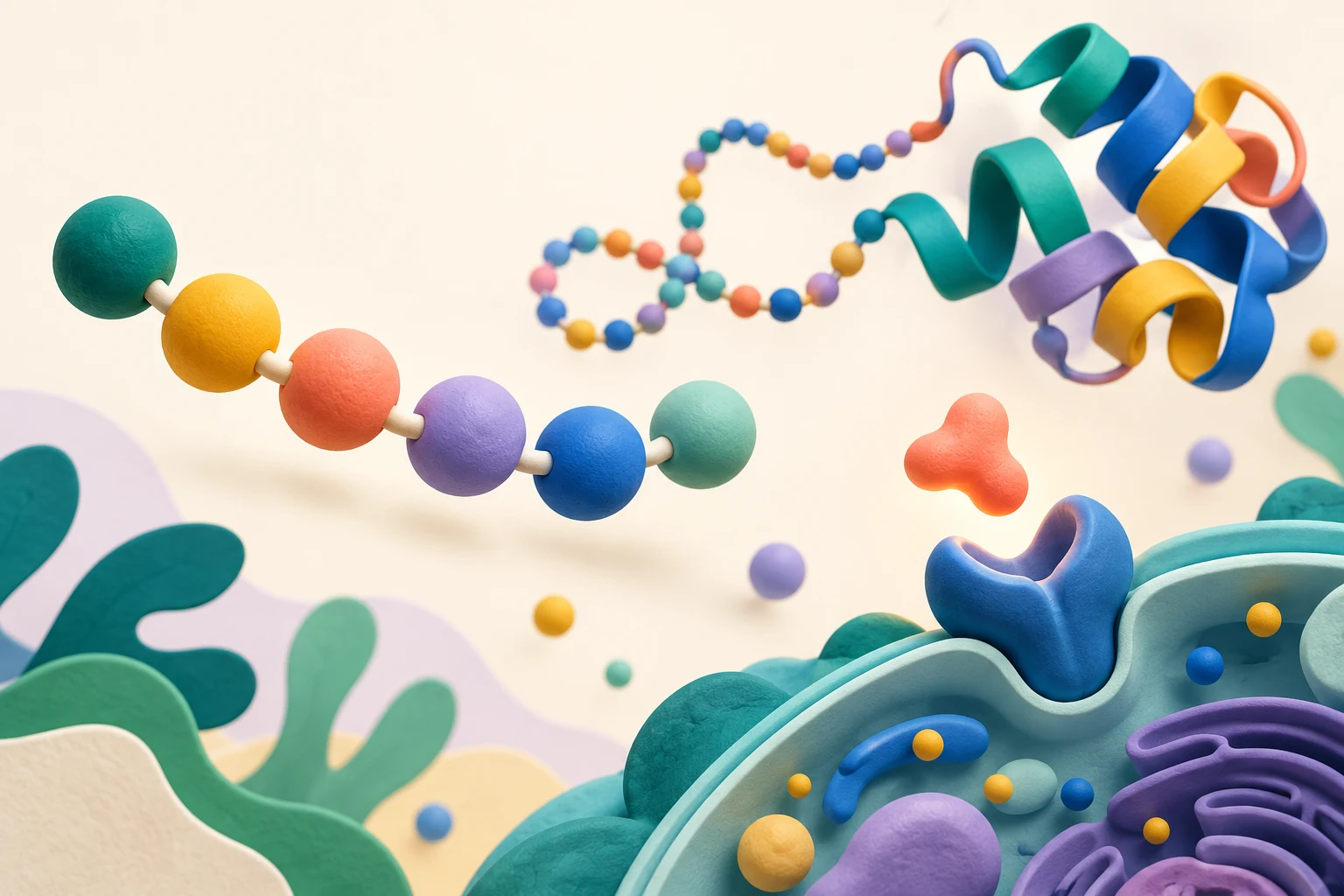
01 / LEARN THE BASICS
What is a peptide?
Say it like PEP-tide. A peptide is a short chain of tiny parts called amino acids. Think of beads on a string. Each bead is one amino acid. The links hold the beads together.
Your body makes peptides. Scientists can also make them in a lab. The order of the parts matters. Change the order, and the chain may do a different job.
Peptide is the name of a group. It is not one product. Asking “Are peptides good?” is a bit like asking “Are tools good?” You need to know which tool, what job and who will use it.
Read more: NIH: What is a peptide?
02 / LEARN THE BASICS
Peptides and proteins: what is the link?
Peptides and proteins use the same kinds of building blocks. A peptide is usually a short chain. Proteins tend to be larger. Their chains fold into shapes.
Those shapes help proteins do their jobs. Some give cells support. Some help move things. Others help the body run small tasks. The shape is part of the story, not just the length.
Here is a simple way to picture it: a few beads make a short chain. Many beads can make a long chain. Fold that chain, and it can take a new shape. Our pictures use this idea. They are not exact maps of a molecule.
Read more: NIH: What is a peptide? · NIH: How proteins form
03 / LEARN THE BASICS
How can a peptide send a message?
Some peptides act as signals. A signal is a message. Cells are the tiny units that make up your body.
A cell may have a place where a signal can fit. This place is called a receptor. Think of a key and a lock. When the right signal fits, it may tell the cell to do a task.
This is a simple picture of a complex job. Not every peptide is a signal. Not every signal fits every cell. More of a signal does not always give a better result.
Read more: NIH: Science words, including cell receptors
04 / LEARN THE BASICS
What benefits are proven?
Some peptide medicines have real uses. The benefit belongs to the exact medicine, for the people and health need studied. It does not apply to every peptide sold online.
Insulin is one well-known example. It helps move sugar from the blood into cells for energy. Insulin medicine helps people with type 1 diabetes, and some with type 2 diabetes, control blood sugar. Diabetes is a health problem that can make blood sugar too high.
Some drugs based on a signal called GLP-1 also help control blood sugar. Some are used for weight care in people who meet the drug’s rules. Semaglutide is one example. The brand and approved use matter. These drugs can have side effects, such as an upset stomach, and some risks can be serious.
These examples show why peptide science matters. They do not prove that a different vial, blend or store product has the same benefit. A licensed health worker can help weigh a medicine’s benefit against its risks.
Read more: MedlinePlus: Human insulin · MedlinePlus: Semaglutide · Health Canada: Check an approved drug
05 / LEARN THE BASICS
Four things that should not get mixed up
The word peptide can show up in very different places. Keep these groups apart when you read a claim.
- In your body: peptides may do normal body jobs. That does not mean taking extra is helpful.
- In a medicine: the exact drug, use and quality need to be checked. A familiar ingredient name is not enough.
- In a cream or food product: a result for that product does not prove a result for an injection.
- In research: scientists may still be learning what a peptide does. A study is a question being tested, not a promise.
Read more: NIH: What is a peptide? · Health Canada: Warning about unapproved peptide injections · NIH: Research benefits, risks and safety · NIH: Questions about supplements
06 / LEARN THE BASICS
What about healing, muscle, sleep or longer life?
You may see big claims about these goals. First ask: “Which peptide? Which product? Which study?” A hopeful idea is different from a proven health benefit.
A test in cells may help scientists choose the next question. A test in an animal may teach them more. Neither one proves that a product works well in people.
BPC-157, TB-500 and CJC-1295 are names you may see online. Health Canada names unauthorized injections with these ingredients in its peptide warning. A name in a study is not proof that a seller’s product is approved.
For a claim about injury, aging, sleep or focus, ask for good human studies on that exact use. If they are missing, “we do not know yet” is an honest answer.
Read more: Health Canada: Warning about unapproved peptide injections · NIH: How to read a health study
07 / LEARN THE BASICS
How do you spot stronger proof?
Evidence means facts from careful study. One post, review or photo is weak proof of a health benefit. People can feel better or worse for many reasons.
A trial is a study in people. A fair test may compare groups. One group gets the treatment. Another gets a different treatment or a look-alike with no active drug. That look-alike is called a placebo.
Ask how many people took part. Ask what changed, how much it changed and how long it lasted. Ask what harms were found. A small test over a short time can miss rare or late harms.
More than one good study can make a finding more useful. Still, no study can promise the same result for every person.
Read more: NIH: How to read a health study · NIH: Research benefits, risks and safety
08 / LEARN THE BASICS
What should readers in Canada check?
For a drug, check the exact product in Health Canada’s Drug Product Database. Look for its eight-digit Drug Identification Number, or DIN. Match the name, maker, strength and form. A copied number on a website is not enough.
Health Canada says prescription drugs should come from a licensed pharmacy and be used with a licensed health worker’s care. “Research use only” does not mean a product is approved for people.
A store listing, nice box or lab report does not prove approval. Neither does a listing on GotPeptide. Check the current record, not just an ad.
Read more: Health Canada: Check an approved drug · Health Canada: Warning about unapproved peptide injections
09 / LEARN THE BASICS
Why does quality matter?
A drug needs the right contents and strength. It also needs to be made and stored the right way. A label alone cannot show all of this.
Unapproved injections may have the wrong amount, other hidden ingredients or germs. They can cause serious harm. Side effects and drug interactions also matter. An interaction is when one drug or product changes how another works.
A purity report asks a narrow question about a tested sample. It is not a full safety check for a person. Ask what was tested, who tested it and whether the report matches the exact batch.
Read more: Health Canada: Warning about unapproved peptide injections · Health Canada: Check an approved drug
10 / LEARN THE BASICS
How do you read the numbers on a pack?
Keep the product name, amount, number of items and price together. A milligram, written mg, is a small unit of weight. A millilitre, written mL, is a small unit of liquid volume. They measure different things.
A pack amount is not a dose. A dose is the amount a person is told to use. This guide does not tell you a dose or how to mix or inject a product.
If the pack facts are clear, price per mg is pack price divided by total mg. For example, a made-up $100 pack with 10 mg costs $10 per mg. That is price math only. It says nothing about the product’s quality, benefit or safe use.
Two prices can use different currencies or leave out shipping and tax. Check those too. Leave a number as “unknown” when the facts are not clear. A guess can make a cheap-looking pack seem like a better deal than it is.
11 / LEARN THE BASICS
Seven questions to take to a health visit
You do not need to know every science word. Bring the product name or a photo of the label. Ask for plain answers.
- What health problem would this exact medicine treat?
- Is this exact product approved here for that use?
- What human studies show a useful benefit?
- What side effects and long-term risks should I know?
- Could it affect my other drugs or health problems?
- What other choices might help, and what do they cost?
- How would we know if it helped, and when would we stop?
12 / LEARN THE BASICS
How can GotPeptide help?
We make product lists and price facts easier to read. You can explore compound names, compare pack details and see when a seller’s price was checked.
Our directory does not test what is in a vial. A listing or paid feature is not a health recommendation. Related-business and paid placements are marked.
Use the site to learn words and ask better questions. Use a licensed health worker for care. You can also sign up for free market alerts and choose which seller updates to follow.
QUICK ANSWERS
Common questions about peptides
Are all peptides the same?
No. Peptide names a large group of short chains. Different chains can do different jobs. Check the exact product and use.
Are peptides the same as steroids?
No. They are different types of molecules. A peptide is made from amino acids. The word peptide still does not tell you whether a product is safe or useful.
Does “natural” mean safe?
No. Where a substance comes from does not settle its risks. The exact product, amount, use and person all matter.
Can a peptide help me heal faster?
You need good evidence for the exact product, injury and person. A lab result or online story is not enough. Ask a licensed health worker about proven care.
Is a research-use label a safety check?
No. It does not make a product approved for use in people.
Can I choose a dose from a price page?
No. Pack amounts and price per mg are facts for comparing packs. They are not directions for treatment.
Why can an approved drug and an online vial share a name?
An ingredient name does not prove the contents or quality of a vial. Approval applies to an exact product. Check the record and the source.
Can I share the picture below?
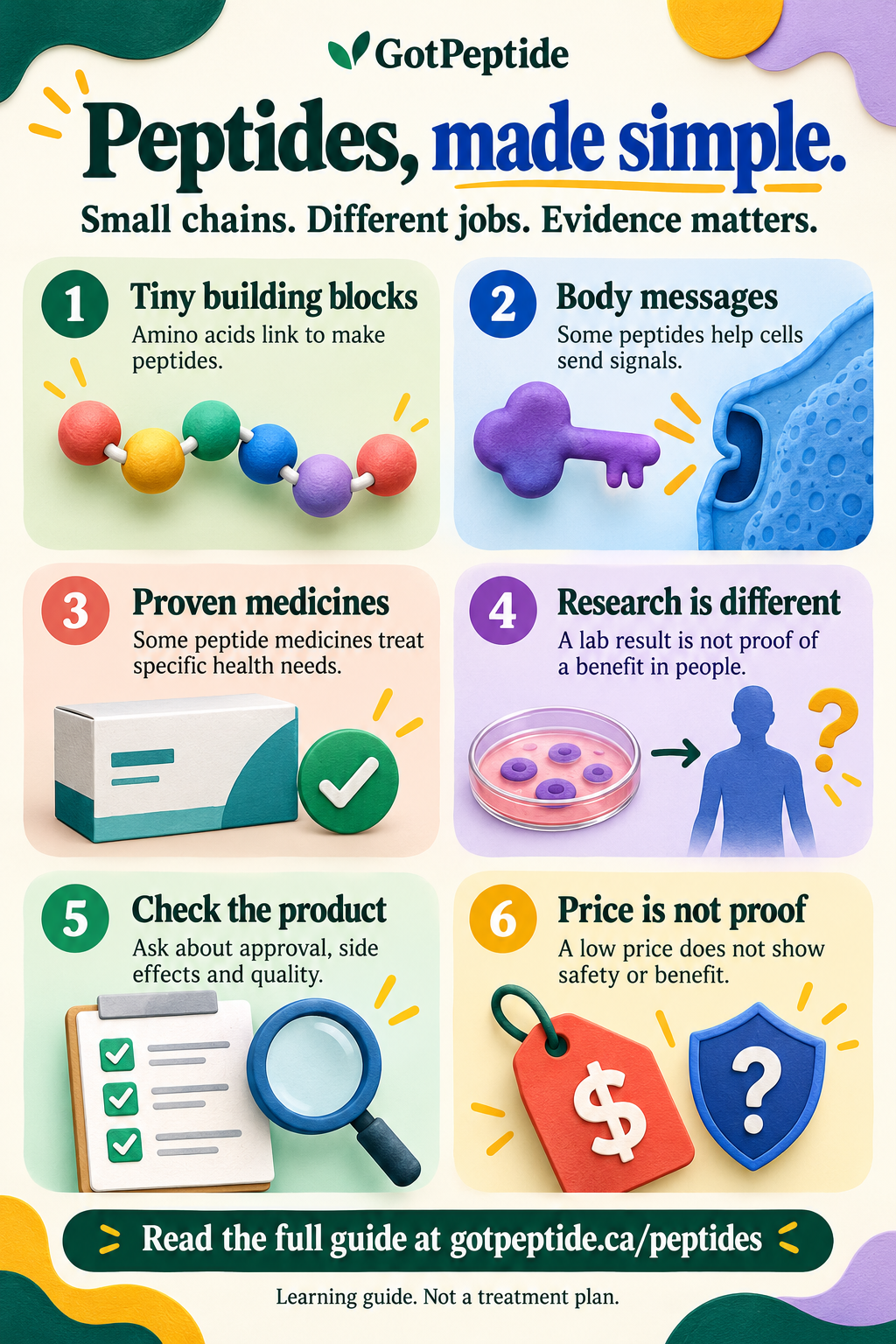
Yes. Save the PNG and share it with the guide link. The six key points are also written as text below the image.
SAVE IT. SEND IT. KEEP LEARNING.
The six-point picture guide.
A colourful reminder of the basics. Save the PNG or send this page to a friend.
Save the infographic PNG ↓Share this page
The same six points, as text
- Tiny building blocks. Amino acids link to make peptides.
- Body messages. Some peptides help cells send signals.
- Proven medicines. Some peptide medicines treat specific health needs.
- Research is different. A lab result is not proof of a benefit in people.
- Check the product. Ask about approval, side effects and quality.
- Price is not proof. A low price does not show safety or benefit.
Sources and updates
We used public health and science sources below. We explain them in our own words. Check the links for the full facts and newer updates. This page has not been independently reviewed by a clinician.
- NIH: What is a peptide?
- NIH: How proteins form
- NIH: Science words, including cell receptors
- MedlinePlus: Human insulin
- MedlinePlus: Semaglutide
- Health Canada: Warning about unapproved peptide injections
- Health Canada: Check an approved drug
- NIH: How to read a health study
- NIH: Research benefits, risks and safety
- NIH: Questions about supplements
GotPeptide also lists stores, including related businesses and paid placements. Those relationships do not prove a health claim. Read how we work and our health and safety context.